
Read Chattooga Property Tax Records
Chattooga County property tax records live in two offices, and each one answers a different question. The Board of Tax Assessors sets fair market and assessed values and keeps the certified tax roll. The Tax Commissioner applies the bill, takes payment, tracks delinquency, and runs tax-sale work. Keep the roles straight. A value field is not a payment field. And a paid bill is never proof of title.
| Field | What It Shows | Where |
|---|---|---|
| Fair market value | Assessor's estimate of full value | Tax Assessor roll |
| Assessed value | Georgia's taxable assessment level before exemptions | Tax Assessor roll |
| Exemptions | Approved reductions or special treatment | Assessor and bill |
| Bill and status | Amount, year, paid or unpaid condition | Tax Commissioner |
| Fi fa or sale trail | Recorded claim and enforcement steps | Commissioner and Clerk |
Georgia generally assesses taxable property at 40 percent of fair market value. Exemptions come off next, producing net taxable value, and millage is applied to that figure. These numbers exist for taxation only. They are not a sale price. They are also not a private appraisal or a forecast of what a buyer might pay.
Separate Chattooga Tax Offices
The Chattooga Tax Assessor sits at 120 Cox Street in Summerville, reachable at 706-857-0737, with weekday hours of 8:30 a.m. to 5 p.m. Values, parcel characteristics, returns, appeals, new improvements, division or transfer work, and conservation-use matters all run through this office.
The Tax Commissioner shares the Cox Street annex and answers at 706-857-0703. Its posted hours run 7:30 a.m. to 5:30 p.m. on Monday, Tuesday, Thursday, and Friday, with Wednesday closed. Direct questions about bills, payment status, delinquencies, fi fas, and tax-sale material to this office.
Decode Chattooga Tax Values
The county tax FAQ lays out the working order. Take assessed value, subtract exemptions, and you get net taxable value. The millage rate then applies to that net figure. A mill simply means one dollar of tax per thousand dollars of taxable value. Several taxing authorities can feed the final bill. So the net millage line and the tax year need to stay attached to any amount you record.
- Fair market value
- The assessor's estimate of full value for tax purposes.
- Assessed value
- The value produced by Georgia's assessment level, generally 40 percent.
- Homestead exemption
- An approved tax reduction with its own eligibility and filing rules.
- Millage
- The levy applied per thousand dollars of taxable value.
- Tax fi fa
- A recorded claim for unpaid tax, not an ordinary ownership deed.
Conservation-use and Freeport programs also show up in county materials. A parcel label alone proves nothing about eligibility. Confirm the application, approval, year, and effect with the assessor before relying on it.
Look Up Chattooga Tax Bills
The Chattooga tax portal is the official online route to bill lookups. The page builds its fields in the browser, so field labels can vary; treat what the live page shows as the authority rather than any assumed search box. If the page fails to load or the record is older, call or visit with the map or parcel number, taxpayer name, bill number, and tax year in hand.
- Find the parcel and certified-roll details in qPublic, then save the exact parcel notation.
- Open the Tax Commissioner portal and search with the live fields it presents.
- Match the parcel, taxpayer, year, and bill status. Do not combine figures from different years.
- Compare exemptions with the assessor record and ask about any delinquency, fi fa, or sale trail.
- Bill year
- The tax period to which a charge and payment apply.
- Payment status
- The portal or office's record of what remains due.
- Penalty
- An added charge governed by timing and statutory rules.
- Tax lien
- A claim for unpaid tax that must be checked for release or satisfaction.
See the Chattooga Tax Portal
The official Tax Commissioner bill page is the online destination for Chattooga County property tax records.
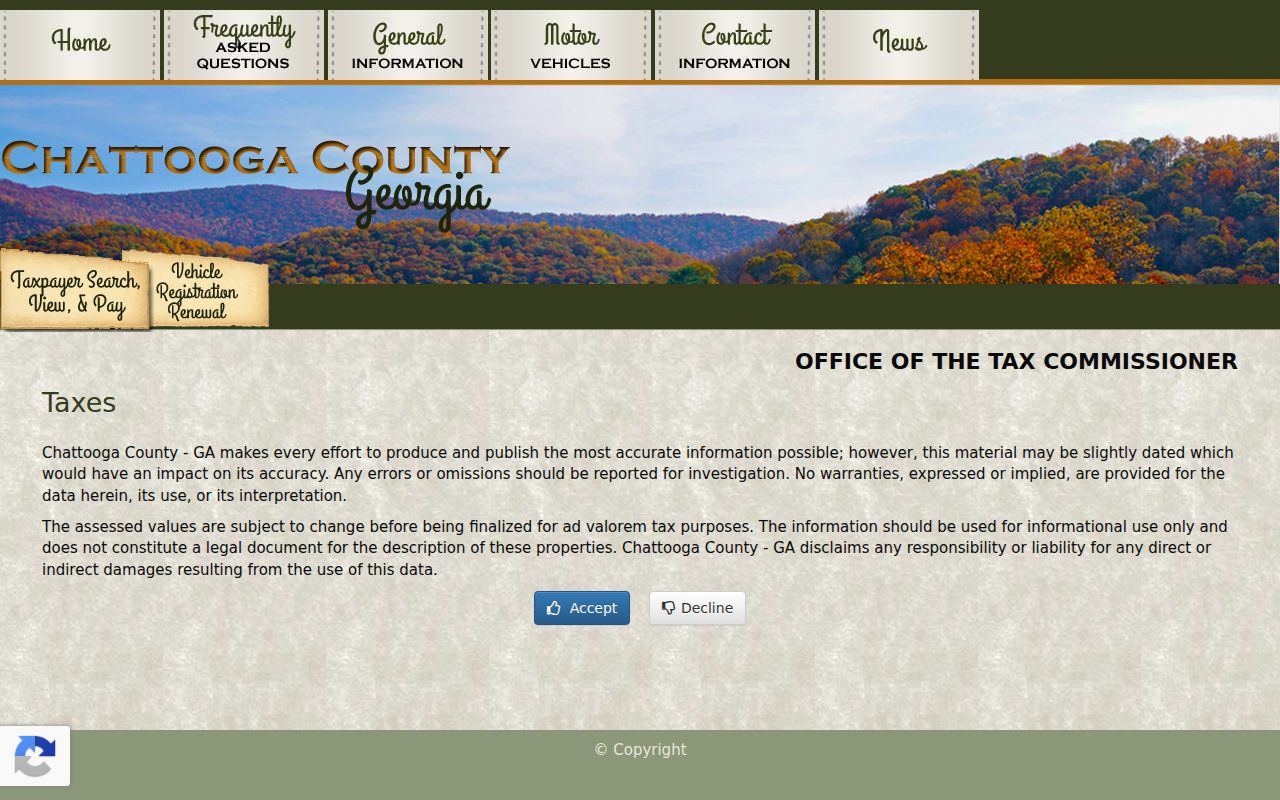
No single page view captures every current field or historical year. Read the live controls themselves and fall back on the office when a bill will not surface.
Track Chattooga Tax Due Dates
County guidance sets normal due dates. Real estate and business personal property taxes are due December 1. Mobile and manufactured home tax is due April 1. Interest starts running after the due date. The FAQ also describes a 5 percent penalty when tax stays unpaid for 120 days. A stated exception covers homestead property under $500.
A mailed bill may go to both an owner and a mortgage company. That does not shift the duty to verify payment. Keep a receipt or portal confirmation tied to the parcel and year. Ask the Tax Commissioner about current interest and penalty math rather than estimating it.
Verify Chattooga Tax Exemptions
Homestead, conservation-use, and Freeport programs all appear in county tax materials. But none is a generic deduction. The assessor decides whether a program applies and for which year. Check the application, approval, parcel, and notice directly. An older exemption may not control the current bill.
Remember what an exemption actually changes. It lowers net taxable value, not recorded ownership or sale price. If an assessment notice denies an exemption, Georgia's appeal form recognizes denial as a ground. So contact the assessor early enough to confirm the proof and filing route.
Follow Chattooga Delinquent Taxes
An unpaid bill can move toward a tax fi fa recorded with the Clerk of Superior Court. It can then pass into public tax-sale steps. A 2017 sale notice shows how dense these records get. Parcel number, deed book and page all appear there. Land lot, district, section, subdivision lots, plat page, address, and tax years all sit in one document. That older notice works as a cross-reference example, not a current sale list.
For a live case, verify the parcel, the years, principal, interest, penalties, sale status, and the recorded reference. Also check any later payment or cancellation. A tax-sale deed can still be subject to statutory redemption and other rights. A posted notice alone proves neither that a sale occurred nor that title is clear.
Note: Confirm current sales with the Tax Commissioner, the Clerk, and the sheriff. Check official legal-notice channels too.
Chattooga's Digest Shift
Chattooga County's digest has climbed steeply over its five-year history. Real and personal digest value sat at $443,791,939 in 2018. It reached $580,568,843 in 2022 and then $760,908,934 in 2023. Net digest moved from $357,830,544 up to $626,402,402 across that span. Millage headed the other way, with net maintenance-and-operations rate falling from 12.6830 to 10.8980 even as the related tax total grew.
These are countywide numbers, not a promise about any single parcel in Chattooga County. One property records entry can rise faster or slower than the whole, since value, exemptions, and millage pull a tax bill in different directions. For the newest published material, the county forms and digest archive is the right stop.
Appeal a Chattooga Assessment
Georgia's PT-311A form opens the appeal path in Chattooga County. Grounds can include taxability, value, uniformity, or a denied exemption. The taxpayer identifies the parcel and assessment notice, states the grounds, picks an appeal method, signs, and files with the county Board of Tax Assessors. Evidence should fit the claim. Comparable sales or condition facts support a value argument. Similar assessment records back a uniformity claim. Filed documents prove an exemption issue.
Delivery rules can change, so confirm Chattooga's filing address and whether email works. Keep proof of delivery and a copy of the notice. The deadline runs from that notice, not from the tax-bill due date. Missing it can sink an otherwise solid appeal.
Appeal window. The PT-311A instructions state that an appeal must reach the county Board of Tax Assessors within 45 days of the assessment notice.