
Build a Chattooga Owner Record
The Assessor's qPublic card is the right place to confirm the present owner of record in Chattooga County. Field labels on the live card are the authority. So copy them exactly as the card displays them. Keep in mind what the county publishes. The data is the most current tax digest, not a deed record that refreshes at every closing. Treat the card as the assessor's snapshot of ownership, not a substitute for the recorded deed. For a parcel number search in Chattooga County, the qPublic card remains the fastest path. It leads straight to a current owner name.
| Published owner | Copy the qPublic owner label and name verbatim |
|---|---|
| Mailing address | Destination for tax correspondence, not the property itself |
| Situs address | Physical parcel location |
| Parcel number | Administrative key that joins card, map, and request |
| Legal clues | Subdivision, lot, land lot, district, section, or book/page |
| Source date | Date searched and assessment year shown |
Skip any vesting guess that the card itself does not state. Ownership may be joint, held in trust, or vested in an entity. Only the recorded instrument settles that question. The card's mailing address can be a lawful contact lead. It proves nothing about who lives there. The official Tax Assessor page names the office that publishes the record.
The assessor route holds up. Still, a live qPublic card remains the way to pull a parcel-specific current owner name for Chattooga County.
Date Chattooga's Current Owner
Chattooga County publishes no fixed nightly refresh. There is no standard lag between a closing and the updated roll. The safe wording is "owner on the latest published tax roll." Note that wording with the date you accessed it. Calling that person the deeded owner today overstates what an assessor record proves. The gap matters most after a sale, an estate transfer, a tax sale, a merger, or a parcel split. A careful owner check keeps both dates. Compare the qPublic card against the newest matching deed. If they disagree, ask the Assessor and the Clerk for clarification.
Note: Chattooga's published tax roll is a dated administrative record. GSCCCA can hold a newer recorded deed.
Verify Chattooga's Current Owner
Open the Chattooga qPublic entry for the published owner card. Then run the name through the GSCCCA name index for recorded confirmation. Match the land details, not just the name.
- Open the parcel card and record the owner, APN, situs, mailing address, assessment year, and legal clues.
- Search the owner as grantee and grantor in Chattooga County, then compare the newest deed's date and description.
- Use book/page or instrument details to confirm the exact recording. Obtain a certified copy from the Clerk when reliance matters.
- If an entity owns the parcel, inspect its state filing. If an estate is involved, request the named Probate Court file.
- Owner of record
- The party named on a stated public record as of that record's date.
- Vesting
- The words in a deed that state how the grantee receives the interest.
- Grantee
- The party receiving the interest described by the deed.
- Registered agent
- An entity's official state-listed contact, not necessarily its property manager or occupant.
Inspect Chattooga's Recorded Proof
GSCCCA's index offers name, book/page, property or subdivision, lien, and plat routes. Its statewide coverage narrative says 1999 forward. Earlier years are being added. The inspected portal displayed a 1990-through-current range. Confirm Chattooga-specific coverage before relying on either date for a particular deed.
The official index image shows the recorded-search source used to confirm a current owner. Open the GSCCCA grantor-grantee search to try its live controls.
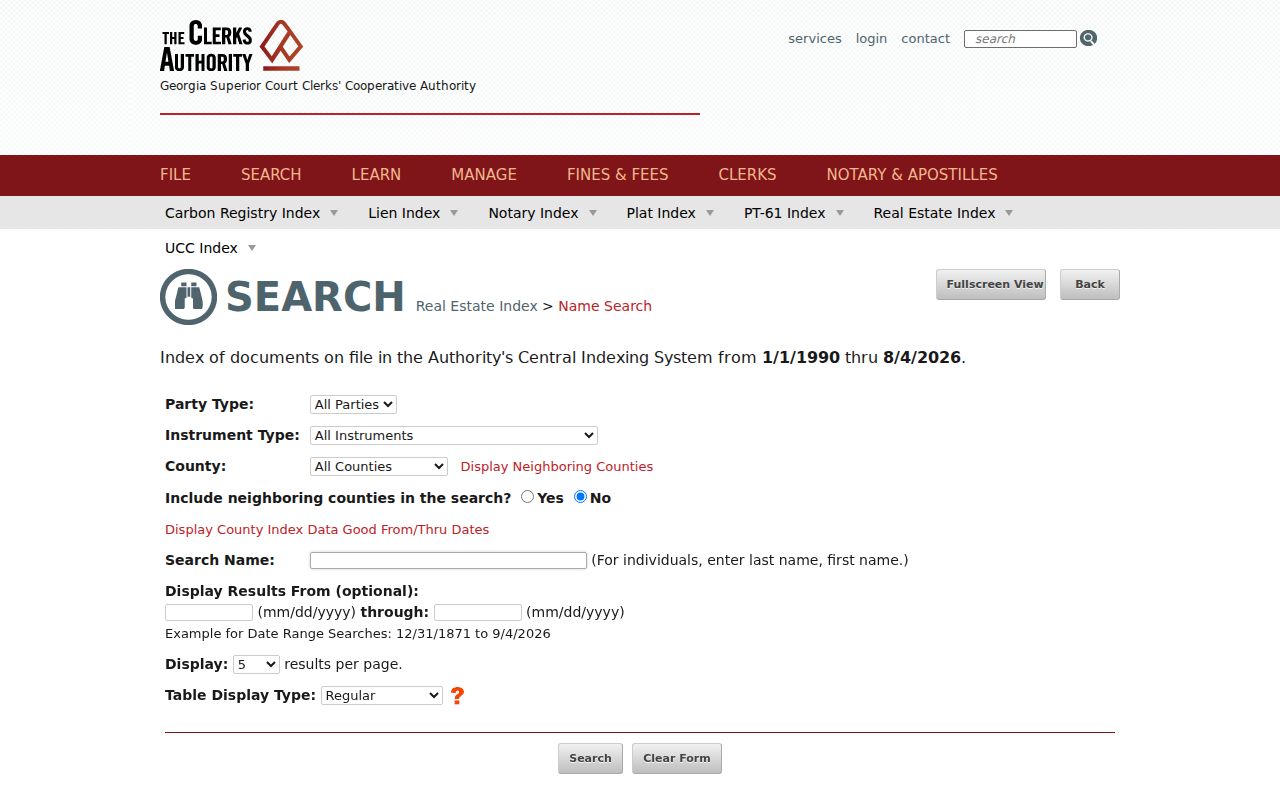
County, party role, name, instrument, and date filters will narrow the candidate deeds. Only the legal description proves which deed touches your parcel.
Check Chattooga Entity Owners
When the owner name is an LLC or corporation, search the Georgia Secretary of State business records by exact name. You can also search by control number. The filing may show status, a registered agent, and officer information. Those fields explain the entity record but do not move title.
A trustee may hold record title for a trust. An executor or administrator may act for an estate. Chattooga Probate Court, at 10035 Commerce Street, can supply a specific estate file through its counter. No public searchable estate docket is available. Follow any authority to convey into GSCCCA.
Read Chattooga Owner Transitions
A homestead exemption is a tax-program flag. It does not prove the named person lives at the parcel. It also does not prove clear title. A tax bill can also go to both an owner and a mortgage company. Keep exemption, mailing, possession, and title as separate questions.
Tax-sale and estate transitions need extra care. An unpaid bill may lead to a fi fa recorded with the Clerk and a public tax sale. The later deed and redemption status govern the ownership trail. Probate petitions and representative appointments can explain why the roll lags behind a transfer.
Request Chattooga Owner Records
If qPublic fails, call the Tax Assessor at 120 Cox Street, Summerville, 706-857-0737, Monday through Friday, 8:30 a.m. to 5 p.m. Ask for the published parcel card by address or APN. For a certified deed, contact the Clerk of Superior Court at 10035 Commerce Street, 706-857-0706. A Georgia Open Records Act request works for any non-posted county record. Name the custodian, parcel, address, record type, date range, and preferred electronic format. Agencies generally must respond within three business days. The response is the record, a schedule and estimate, or a cited exemption.
Preserve a Chattooga Verification File
Keep a verification file. Use it whenever you settle a question about who owns a parcel in Chattooga County. Save the qPublic card, the parcel number, and the situs and mailing addresses. Add the assessment year as well. Add the newest deed reference that matches. Note the grantee's exact wording and the recording date. If you order a certified copy, jot down which office issued it and when.
Write down how you matched the records, too. A street name alone proves little. A matching parcel key makes a far stronger case. So do the land lot, district, subdivision lot, acreage, and prior deed reference. A deed may describe a larger parent tract. Look for later plats, splits, or corrective instruments before calling it the same present parcel.
After a recent closing, ask the Clerk whether the deed has been indexed. Ask the Assessor which tax roll qPublic currently reflects. That direct check beats any guess about update speed. GSCCCA account and image access may carry a fee. The index search and the county counter remain separate ways in.
Contact a Chattooga Property Owner
The tax-roll mailing address is the contact clue most tightly tied to the parcel. Use it for a good-faith property matter, and don't assume the addressee lives on site. Some qualifying Georgians use a substitute mailing address through the state's victim-centered confidentiality program.
The wider route from an unknown address to a name is laid out in the Chattooga ownership route. Remember that a current owner record is only a dated snapshot. Handle it with care.
Lawful use. Public owner data may support legitimate property contact. Never use it to stalk, harass, intimidate, or harm a person.