
Read Chattooga County Deed Records
The Clerk of Superior Court records Chattooga County deeds. Plats, liens, releases, and security deeds go there too. The deed type states what act occurred, so read the parties, dates, legal description, reservations, and prior references before deciding what changed.
| Deed type | What it does | Common use |
|---|---|---|
| Warranty or limited-warranty deed | Conveys the stated land with the warranties in the instrument | Ordinary transfer |
| Quitclaim deed | Conveys whatever interest the grantor has, if any | Interest release or cleanup |
| Executor or administrator deed | Records a fiduciary's conveyance | Estate transfer |
| Sheriff or tax deed | Records an official sale process | Execution or delinquent tax |
| Security deed | Secures debt rather than ordinary fee title | Georgia financing |
Not every filing near a conveyance is a deed. A lien, easement, assignment, or lis pendens can sit beside it in the record, which is why releases and cancellations deserve the same search as the deeds themselves.
Chattooga's Deed Records Custodian
Georgia gives Chattooga no separate recorder of deeds. The Clerk of Superior Court performs that work at 10035 Commerce Street, Summerville, Georgia 30747, phone 706-857-0706. The counter remains the fallback for older books, certified copies, and anything the web route misses.
The GSCCCA real-estate index offers the statewide online path. Its general account indexes all counties from 1999 forward, with 1993 through 1998 being added. The direct portal shows a 1990 start. Neither statement proves the earliest Chattooga entry. Confirm county coverage for the instrument you need.
Use Chattooga Grantor-Grantee Fields
The name form has controls that cut false matches. Set the county, party role, and date range. Individuals appear last name first, while entities follow the indexed legal name, suffix variants included.
| Field | Input | Purpose | Caution |
|---|---|---|---|
| Party Type | Portal dropdown | Orient grantor or grantee role | List is portal-controlled |
| Instrument Type | Optional dropdown | Narrow the record class | Broad search catches label variants |
| County | Chattooga | Remove statewide namesakes | Neighbor option adds noise |
| Search Name | Person or entity | Find indexed parties | Test initials and suffixes |
| Date From/To | mm/dd/yyyy | Target a transfer period | Execution and record dates differ |
Copy the instrument type, parties, record date, and book/page or instrument number from each candidate result. Display controls only change the view.
See Chattooga Deed Search Fields
The official GSCCCA deed-name search page shows the county, party, instrument, date, and display controls. Each control filters the Chattooga deed index.
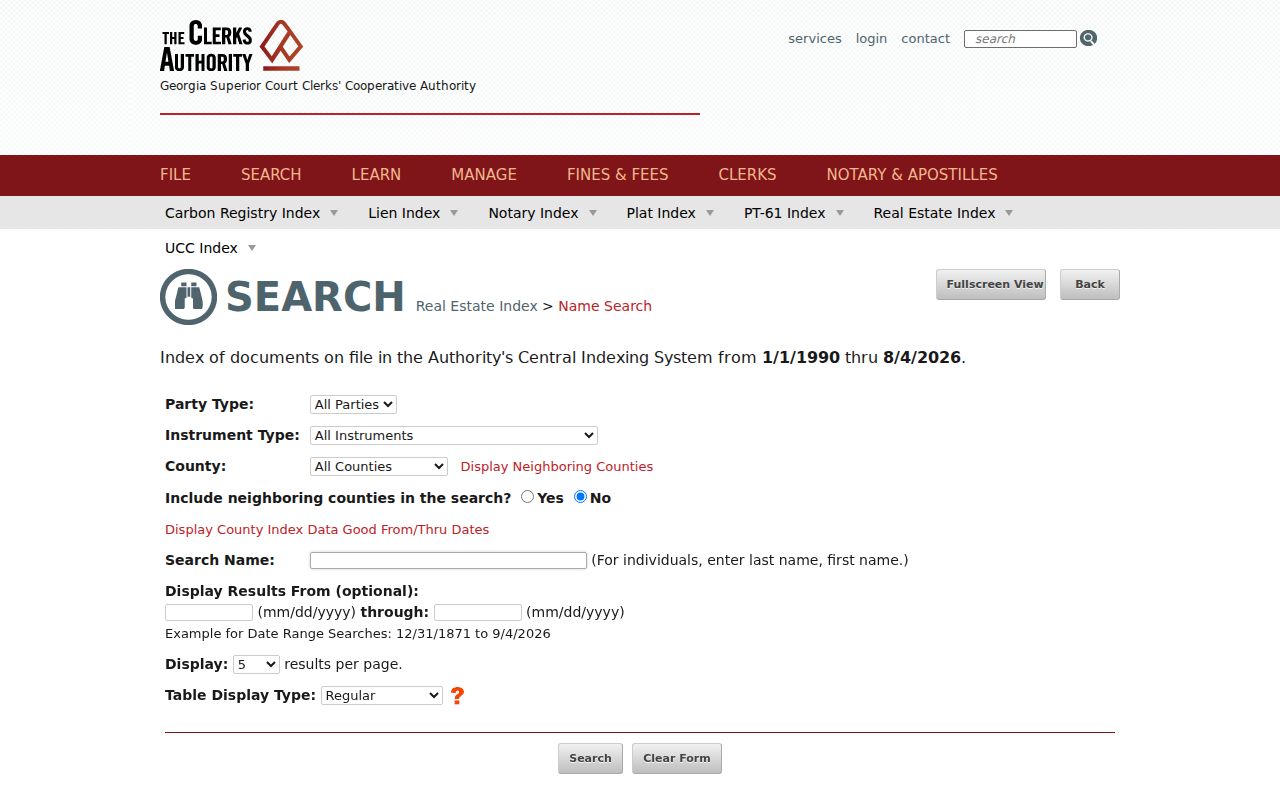
The form is only an index gateway. Tie a result to the land through its legal description and recorded references before calling it a match.
Trace the Chattooga Deed Chain
Begin with the latest confirmed conveyance. A Chattooga County property search supplies the current roll name and parcel clues. Then find that owner's acquiring deed as grantee. Read the complete entry or image.
- Search the current owner in the grantee role and locate the likely acquisition.
- Match subdivision, lot, land lot, district, section, or prior book/page to the parcel.
- Take the grantor's name and search that party earlier as a grantee.
- Follow each prior book/page and plat citation, moving to books or film when the online run ends.
- Grantor
- The party conveying the stated interest.
- Grantee
- The party receiving the stated interest.
- Chain of title
- The linked sequence of conveyances for the same land.
- Book/page
- A volume and page reference used to retrieve an instrument.
Names alone make a weak chain. Estates, trusts, married names, and business suffixes all break clean runs, and a prior-reference clause often closes the gap faster than an open name query.
Search Beyond Chattooga Names
GSCCCA supports more than name lookups. Book/page search takes a county, book, and page. A reference to Plat Book 1, Page 12 belongs on the plat path, where name, section or GMD, district, land lot, and dates all filter the results. Property search centers on subdivision, so a name like Hammond Estate can anchor it. Lien search repeats the party, instrument, county, and date controls. Each route solves a different problem. A security deed still wants its later cancellation or satisfaction. Recorder search is rarely strongest by street address.
Reach Early Chattooga Deed Books
Chattooga County was organized in 1838 from Floyd and Walker counties, with Summerville as the seat from 1839. An early chain can cross parent-county and state land records before any Chattooga deed exists. The land lot is the key. A street address leads nowhere here.
The Georgia Archives county cards map the record groups. Much early material survives on microfilm. The Archives guide films county deed and estate records often to about 1900, with some series running later. FamilySearch catalogs Chattooga estate records from 1856 through 1915 on 28 reels. The library Georgia History Room and the Historical Society add local context through newspapers, church records, business ledgers, and photographs. Those sources explain names and boundary shifts.
Note: No source documents a courthouse fire or destroyed Chattooga deed series, so no loss event should be claimed.
Connect Chattooga Estate Deeds
A death transfer can leave two trails. Probate Court keeps the petition, will, fiduciary appointment, inventory, and notices. That court grants the authority to convey. The Clerk and GSCCCA hold the instrument that actually records the transfer, whether an executor deed, administrator deed, or estate deed.
Search every variant name. Decedent, estate, executor, administrator, and heirs all count. Then compare the parcel and legal description. The assessor may carry an estate or decedent name until a later certified roll, so read the probate authority and the final recorded deed together.
Read Chattooga Security Instruments
Georgia deeds to secure debt function much like mortgages. They live in the same real-estate records system as any other deed. Search both sides: the borrower as grantor and the lender as grantee. From there, track every assignment, modification, cancellation, release, and satisfaction tied to the instrument. Two cautions apply. A security deed never hands the lender ordinary fee ownership. A paid tax bill proves nothing about whether the security instrument was ever released.
Other encumbrances end on their own terms. Judgment liens and tax liens demand a satisfaction, a release, a court order, or some equally effective resolution. An easement can linger until a later release cancels it. A lis pendens signals live litigation. Pair it with the final case disposition before drawing conclusions. Always match each filing to the same property description. A single name can attach to several parcels across the county.
Cross-Check Chattooga Deed References
One 2017 county tax-sale advertisement shows how a single local record can bridge several indexes at once. It carried parcel notation S32--51 and reference deed Book 609/Page 363. It also named Land Lot 50 in the 6th District and 4th Section. It listed Lots 1 through 3 in Block A of Hammond Estate Subdivision, Plat Book 1/Page 12, and a Commerce Street clue.
The advertisement is not a deed image. It proves nothing about present ownership. Its real value is structural. The parcel leads to the assessor, the book and page lead into the deed search, and the plat citation tests whether the land matches. Its buyer-beware language, easements, rights-of-way, covenants, and redemption terms also explain why an official sale notice never equals clear title.
Use Every Chattooga Deed Route
Online search is just one route in. Use GSCCCA for index discovery and its account route for available images. Call or visit the Clerk for certified copies, older volumes, and hard references. Ask there about exact county coverage too. A written request works best for specifics. Name the parties, document type, date span, parcel, description, and desired format.
Early records call for older tools. Georgia Archives county cards and microfilm come first, then FamilySearch catalog numbers to identify reels. The library Georgia History Room and the Historical Society can connect a deed name to newspapers and local histories. They can also reach photos, church files, and business records. Ask about exact year runs, since the public pages do not publish them.
The Georgia Open Records Act generally requires a response within three business days. That response may be production, a production schedule, a cost estimate, or an exemption. The law does not force an office to build a new index.
FANS Is Not Deed History
GSCCCA's Filing Activity Notification System is a free, forward-looking alert service. Its terms describe one-year requests. Its terms also limit use to the registrant's own property or property the registrant is authorized to watch. It does not search the past. It does not certify title.
Statewide FY2025 figures reported 85,246 users and 390,697 matches by July 6, 2025. The GSCCCA image system reached roughly 330 million images. Those numbers describe system scale only. They say nothing about whether a specific Chattooga County deed is available.
Get a Chattooga Deed Copy
The index is free to search, but images and printing carry separate charges. Regular access runs $14.95 monthly. Premium runs $29.95 monthly. A four-hour single use costs $5, and printing costs $0.50 per page. Confirm current prices with the Clerk before paying anything.
Give the Clerk the county and the party names. Include the document type, record date, and book and page or instrument number. Add the property description too. Ask whether inspection, an uncertified copy, or a certified copy fits the need. The Clerk sets the certified-copy fee, so ask directly. Mail and a focused Georgia Open Records Act request remain fallbacks for a specific non-exempt item.
Recorded, not guaranteed. Chattooga County deed records show filed instruments. They do not resolve unrecorded claims, prove survey lines, or provide a title opinion.