
Run a Chattooga Property Search
A Chattooga County property search works best in stages. It should move from the familiar clue to the exact one. An address feels simple. Yet spelling quirks, road suffix changes, E-911 renumbering, and postal-city labels can bury the match. An owner name has its own traps. Trusts, estates, and business names scatter one person across several parcels. Or they lump many parcels under one label. The parcel number is the cleanest cross-reference. The county's qPublic entry page is the assessor starting point. GSCCCA is where the recorded deed trail gets tested.
- Enter the street number and name in qPublic. Try the road name alone if the full address fails.
- Open the likely parcel and record its parcel number, situs address, roll owner, legal-description clues, and record date.
- Carry the owner's indexed name to the GSCCCA name search. Limit the county to Chattooga and narrow the date range.
- Match the legal description, book and page, subdivision, or land lot. Then check the county tax portal for the bill status.
- Ask the custodian for an official or certified copy when the record will support a legal or financial decision.
Write down what each source calls the property. A postal address, a situs address, a parcel key, and a deed description are not the same thing. Keeping all four on paper turns a shaky name match into a record trail you can actually trace.
Choose Chattooga Search Keys
Chattooga County records reward a deliberate choice of key. The assessor accepts owner, address, and parcel routes. The live Schneider application, though, blocks public access, so its exact search labels remain unconfirmed. GSCCCA is not a street-address tool; it performs best after qPublic supplies a name, subdivision, or book-and-page clue.
| Starting clue | Best first source | Useful result | Main risk |
|---|---|---|---|
| Situs address | qPublic | Parcel candidate and roll card | Renumbering or postal-city mismatch |
| Owner name | qPublic or GSCCCA | Parcels or indexed instruments | Name variants and roll lag |
| Parcel/APN | qPublic or assessor counter | Exact tax-map unit | Split or merge changed the key |
| Book/page | GSCCCA | Recorded instrument reference | Wrong county or book series |
Vacant land may carry no street number at all. One address can even serve several parcels. When that happens, lean on the map, legal description, subdivision, or land-lot references instead of forcing an address match.
Read Chattooga Assessor Results
qPublic draws its data from the last certified tax roll. Other details can change without notice. That caveat frames every result. The record is a tax-administration snapshot, not a live feed of this morning's closings. A sale just recorded may not appear yet. Read a result exactly as displayed, and copy it rather than guessing at field labels.
| Function to check | Likely form | What to record | Verified limit |
|---|---|---|---|
| Owner search | Text or search mode | Legal name and variants | Exact label not captured |
| Address search | Text or search mode | Number, road, suffix, postal city | Exact label not captured |
| Parcel search | Text or search mode | Dashes and prefix exactly | Accepted format not captured |
| Parcel card | Result/detail view | Owner, situs, mail, value, description | Latest certified-roll basis |
The property search will sometimes fail to load. Then the official Tax Assessor page is the fallback, and its staff can separate a portal problem from an invalid search key.
See the Chattooga Search Entry
The captured Chattooga qPublic landing page shows the official path into the property search.
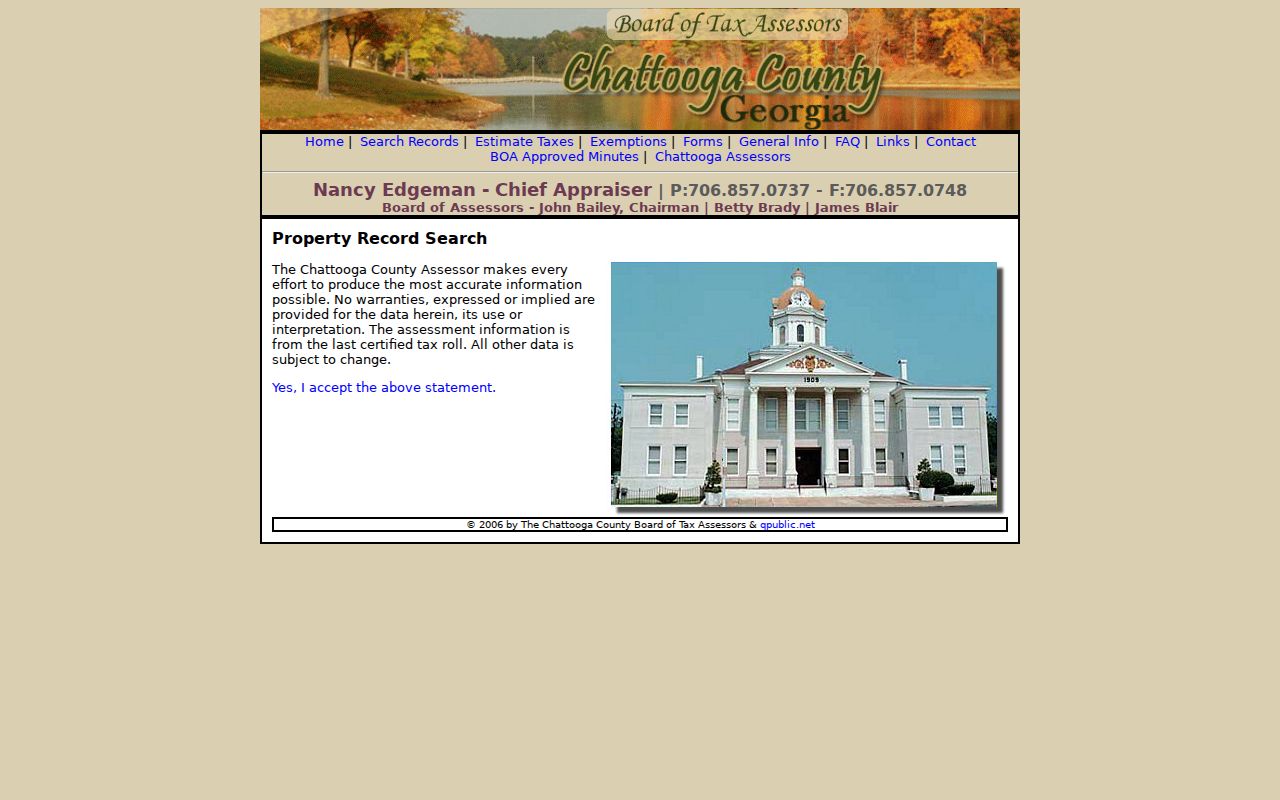
The entry image shows access, not parcel facts. Open the live result, note its roll date, and compare it with the deed before drawing any conclusion.
Test Chattooga Owner Variants
Owner searches cast a wide net. Spelling discipline matters. Try last-name-first, natural order, initials, married-name forms, and estate or fiduciary entries. Companies need care too. Test punctuation and suffixes such as LLC or Inc. A trust may be indexed under its title, a trustee, or both. A registered agent in the Secretary of State file is not automatically the landowner.
Mailing addresses are clues, not proof. They do not prove where an owner lives or what a deed conveys. They may point to a post-office box, a lawyer, a lender, or an out-of-county destination. Match name to parcel and legal description. If a recent sale seems likely, check the GSCCCA record date. A deed can post before the next certified tax roll.
Note: A homestead flag is a tax-program entry. By itself it does not prove present occupancy or title.
Move From Parcel to Deed
A name from qPublic opens the recorded trail. From there, the Clerk of Superior Court and GSCCCA carry the story forward. The name-search form hands Chattooga County property search users genuine controls. Party type, instrument type, county, and date range can all be set. So can a neighboring-county display before the search runs. Start tight. One county and a narrow date window will surface most transfers. Widen the range only if the expected deed stays hidden.
Keep two products straight. The free index and the paid deed image serve different steps in the same hunt. GSCCCA also routes searches through book and page, property or subdivision, plat, and lien fields. Viewing an image or printing one may call for an account or a single-use payment. Certified copies are another matter entirely. The Clerk counter at 10035 Commerce Street in Summerville still handles those. It also handles any records the online path leaves out.
Want a closer look at instruments and chain work? The Chattooga County deed records page breaks it down.
One Chattooga Record, Many Keys
Cross-references earn their keep. A 2017 tax-sale notice proves the point. It tied parcel notation S32--51 to Book 609, Page 363; Land Lot 50 in the 6th District and 4th Section; Lots 1 through 3, Block A of Hammond Estate Subdivision; Plat Book 1, Page 12; and a Commerce Street address. No single key held the whole identity. Each one pointed at the rest.
Treat that old notice as a specimen, not an answer. It cannot tell you the current owner of record. Pick one of its keys instead, then confirm the others against today's assessor, deed, plat, and tax systems. Parcel notation sometimes shifts after a split or merge. A recorded legal description, by contrast, may preserve the older lot and land-lot language that ties everything back together.
Follow Chattooga Address Changes
Chattooga County's 2025 E-911 packet documents every new or changed address. It applies broadly. A single-family home, apartments, a trailer, a modular or manufactured structure, a tiny home, a barn or shop, and an agricultural water meter all fall within it. The packet also requires driveway marking plus signoffs from code enforcement, environmental health, and a city where one has jurisdiction.
That paper trail solves a common puzzle. A deed may carry an older land description. It may no longer match the current street number, and the packet explains the shift. It routes updates among assessor, code, health, and local approval records. It also tells the owner to notify the assessor once construction wraps up. A search may turn up nothing. Then ask the proper custodian for the parcel, the address assignment, the approval date, and any prior address.
What Chattooga Search Results Show
A full Chattooga County property search inventory would list both the visible and the missing. No live parcel card appears here, so treat the fields below as items to confirm on the current card. A result may show some but not all of them.
| Roll owner | Exact indexed name and the date or roll year attached to it |
|---|---|
| Situs and mailing addresses | The land's location compared with the destination for tax mail |
| Parcel/APN | The assessor's administrative key, copied with all prefixes and dashes |
| Value fields | Land, improvements, fair market, assessed, and exemptions only when shown |
| Legal-description clues | Subdivision, lot/block, district, section, land lot, and plat references |
| Sale fields | Date, price, and recording reference only if the live card identifies them |
One caution on cards. A parcel card proves neither a surveyed boundary nor clear title. Check any sale field against the deed image and its legal description, and never let a cached owner name stand in for a dated official result.
Recover a Failed Chattooga Search
A blocked screen or an empty result is not proof the record is gone. Simplify the query first. Drop the road suffix, try the street name alone, flip the owner-name order, and test the parcel with and without punctuation only if the live form allows it. qPublic's accepted formats should be verified rather than assumed.
Phone calls come next. The Tax Assessor handles questions when you supply the address, a parcel clue, an owner variant, and the date in question. Bill history sits with the Tax Commissioner. A deed, plat, lien, or release belongs to the Clerk and GSCCCA. Completed E-911, permit, preliminary-plat, or county code files may still rest with the office that created them, while older deed and estate leads extend to the Clerk, Georgia Archives, the FamilySearch catalog, the library, or the Historical Society.
A Georgia Open Records Act request should name the custodian, the parcel or address, the record type, the date range, the preferred electronic format, and whether inspection alone is acceptable. State guidance gives the agency three business days to respond by producing the record, setting a production date, estimating costs, or citing an exemption. Search and review charges are reasonable after the first 15 minutes.
Verify Chattooga Search Matches
Test every match on five points. Check the parcel number, situs, legal description, indexed owner, and record date before trusting it. A solid hit should also hold up across the deed's grantor and grantee. It should match the plat or land-lot citation, and the tax year. Any conflict deserves a written note. Ask the custodian which record date controls its system.
Addressing in Chattooga County gets tricky at the edges. A Summerville, Trion, Menlo, or Lyerly postal city proves nothing about incorporation. USPS delivery, municipal boundary, tax district, and recorded land description are separate layers. Record each one separately whenever permits, zoning, or city approval come into play.
Keep every tool in its lane. A map line is not a survey. An assessor owner is not same-day deed proof. An old tax-sale notice is also not a current status report. Each serves well within its purpose.
Compare Chattooga Property Search Routes
Every Chattooga County property search route has a job it does best. Address search nails down a known site, owner search gathers parcels under one name, and parcel search pins a single tax-map unit. Comparing routes beats relying on any one of them alone.
| Search Key | Best For | Where It Works | Watch Out |
|---|---|---|---|
| Address | A known place | qPublic and parcel map | E-911 change or postal-city mismatch |
| Owner name | More than one parcel or a deed trail | qPublic and GSCCCA | Trusts, estates, entities, and same names |
| Parcel number | An exact tax-map unit | Assessor, tax office, and map | Splits, merges, punctuation, or prefixes |
Not a title search. A Chattooga County property search shows public entries, but it does not guarantee clear title, resolve unrecorded interests, or replace legal review.
Agreement across all three keys is the goal. When it happens, save the result date and recording reference. When keys conflict, the documented fallback chain runs through the Clerk, Assessor, Tax Commissioner, county planning office, Georgia Archives, and library.